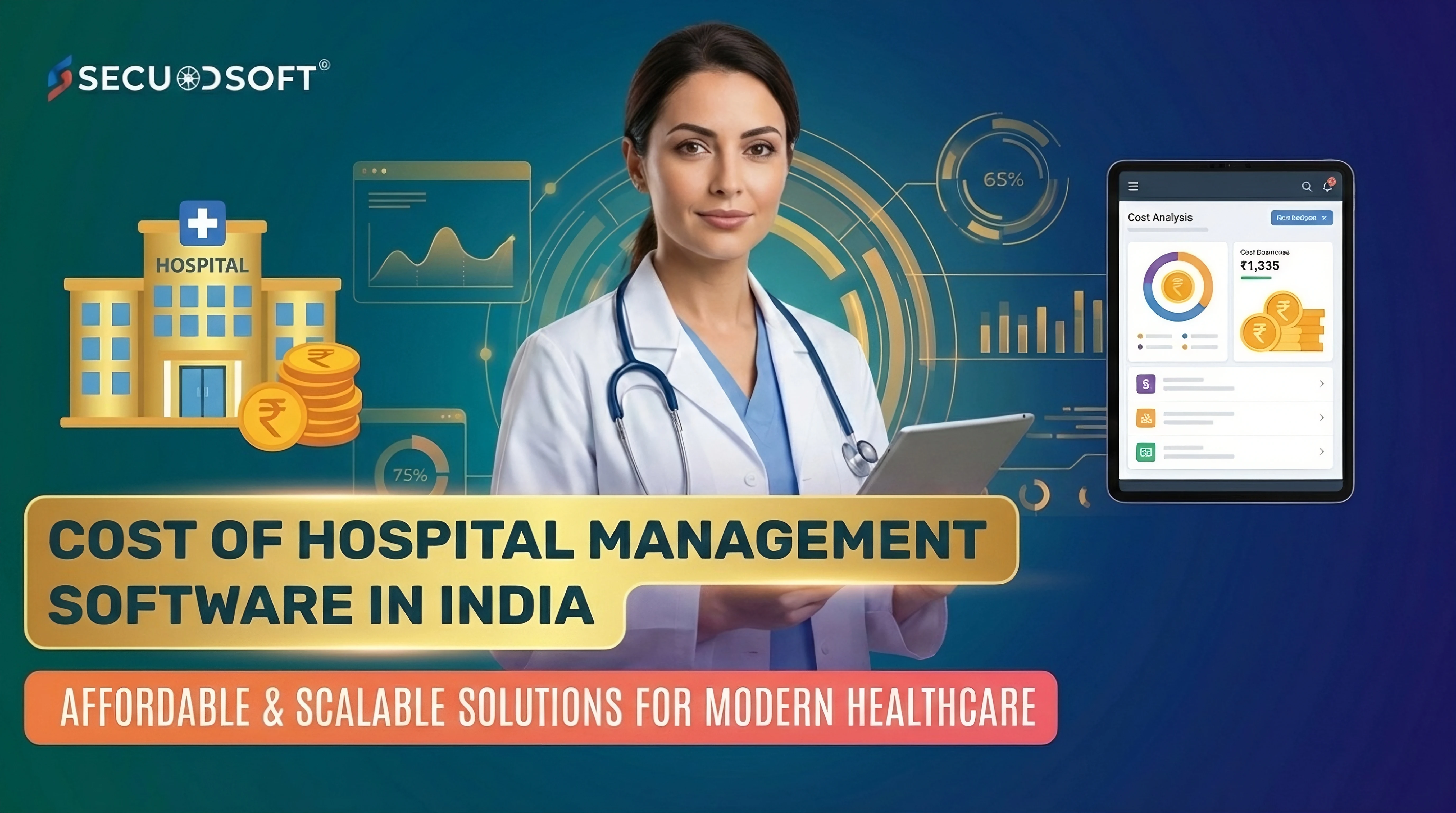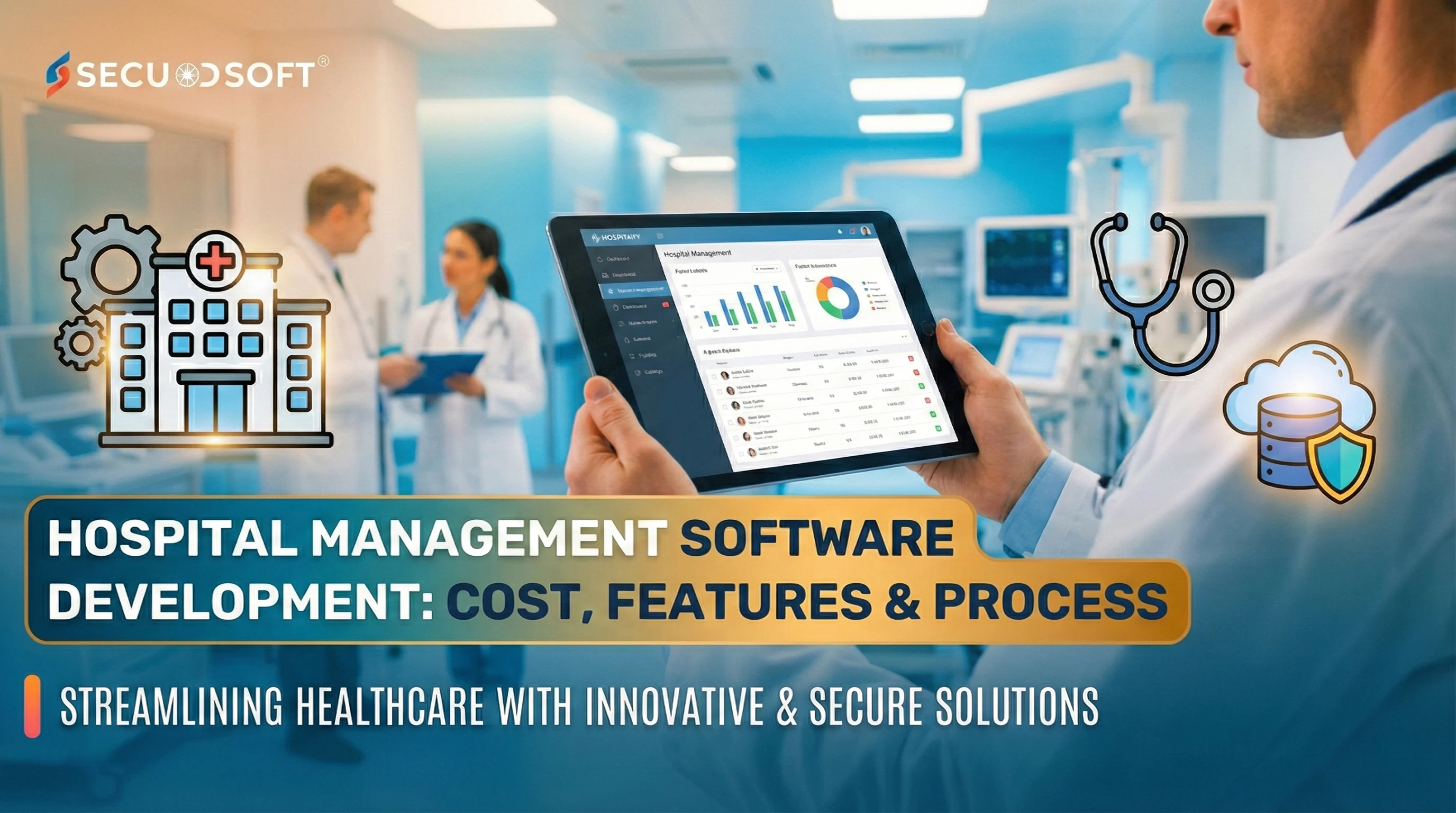
The healthcare industry in 2026 faces unprecedented challenges, rising patient volumes, complex regulatory requirements, and pressure to improve care quality while controlling costs. Hospital management software has evolved from a luxury to an absolute necessity for healthcare facilities seeking operational efficiency and better patient outcomes. Whether you're a multi-specialty hospital in Mumbai, a diagnostic center in Bangalore, or a clinic management software user across India, implementing the right hospital management system (HMS) can transform your operations. However, developing healthcare management software involves significant investment, typically ranging from ₹5 lakhs to ₹2 crores+ depending on scope. Understanding HMS software features, hospital ERP capabilities, and medical management system best practices ensures you make informed decisions that deliver maximum ROI for your healthcare facility.
A hospital management system (HMS) is comprehensive healthcare management software integrating all aspects of hospital operations into a unified digital platform. Unlike standalone solutions, modern HMS software connects patient registration, appointment scheduling, electronic medical records (EMR), billing and payments, pharmacy management, laboratory management, inventory control, and administrative functions into seamless workflows. This integration eliminates data silos, reduces manual data entry, minimizes errors, and provides real-time visibility enabling better decision-making.
Hospital software serves diverse stakeholders, doctors access patient histories and lab results, nurses manage ward activities and medication administration, administrative staff handle registration and billing, pharmacy teams manage inventory, and management monitors operational metrics. Each stakeholder benefits from medical management system capabilities tailored to their workflows while contributing to integrated patient care.
Patient safety and care quality improvements drive HMS adoption. Digital systems reduce medication errors, prevent duplicate tests, flag drug interactions, provide clinical alerts, and ensure complete patient information availability. These capabilities directly impact patient outcomes, with hospitals reporting 20-30% reductions in medical errors after implementation.
Operational efficiency gains justify healthcare management software investment. Automated workflows eliminate redundant data entry, accelerate processes, optimize resource utilization, and free staff to focus on patient care. Hospitals report 30-50% productivity improvements after successful hospital ERP implementation.
Financial management benefits include accurate billing, reduced claim denials, faster payment collection, and revenue cycle optimization. Healthcare facilities typically see 15-25% revenue improvements through better billing accuracy enabled by medical billing software capabilities integrated into HMS.
Patient registration modules capture demographics, insurance information, medical history, and unique identifiers. Advanced systems include biometric authentication, Aadhaar integration, and family linking. Efficient registration reduces wait times and ensures accurate patient identification throughout care delivery.
Electronic medical records (EMR software) digitize patient records including clinical notes, diagnosis information, treatment plans, medication history, and allergy information. Structured data entry with templates ensures completeness while maintaining flexibility. Digital records enable instant access, support care coordination, and eliminate handwriting interpretation issues.
Appointment scheduling enables patients booking online, staff managing doctor availability, automated reminders via SMS/email, and optimized clinic schedules reducing wait times. Smart scheduling considers doctor specialties, consultation duration, and patient priorities maximizing facility utilization.
Medical billing software automates invoice generation, insurance claim processing, payment collection, and accounts receivable tracking. Accurate billing reduces claim denials, accelerates revenue collection, and improves cash flow. Support for multiple payment modes including cash, cards, UPI, and insurance provides flexibility.
Revenue cycle management tracks patient encounters from registration through final payment, identifying bottlenecks and optimizing processes. Analytics reveal patterns in claim denials and revenue leakage enabling corrective actions. Integration with hospital ERP systems provides comprehensive financial visibility.
Pharmacy modules manage drug inventory, supplier management, stock tracking, expiry monitoring, and automated reordering. Integration with prescription orders ensures accurate dispensing, prevents drug interactions, and optimizes inventory levels reducing waste while preventing stockouts.
Laboratory information systems handle test ordering, sample tracking, equipment integration, result entry, and report generation. Barcode-based sample tracking prevents mix-ups, while equipment interfaces automatically capture results reducing errors. Digital reports with reference ranges support clinical decision-making.
Inventory modules track medical supplies, surgical instruments, consumables, and equipment across store locations. Automated reordering based on minimum stock levels prevents stockouts while optimizing inventory investment. Batch tracking and expiry management ensure supply chain efficiency.
Reporting and analytics provide insights into patient volumes, bed occupancy, department utilization, revenue by department, collection rates, and quality metrics. Real-time dashboards enable management monitoring KPIs and identifying operational bottlenecks supporting data-driven decisions.
Hospital management software development cost varies dramatically based on feature scope, customization level, technology stack, integration requirements, and compliance needs. HMS software pricing reflects complexity, basic systems cost less than comprehensive platforms integrating multiple specialties and departments.
| Type | Estimated Cost |
|---|---|
| Small Clinic Management Software | ₹3,00,000 – ₹8,00,000 |
| Medium Hospital Management System | ₹8,00,000 – ₹25,00,000 |
| Large Multi-Hospital ERP System | ₹25,00,000 – ₹60,00,000+ |
Custom development may cost more initially but provides long-term flexibility and scalability.
Ongoing costs include annual maintenance (10-15% of development cost), cloud hosting fees (₹50,000-₹5,00,000 annually), license renewals, and feature enhancements. Budget for these recurring expenses ensuring long-term effectiveness.
Phased implementation reduces initial investment by starting with core modules, adding clinical modules in phase two, and expanding to advanced features in phase three. This spreads costs across 18-36 months while providing early benefits.
Cloud-based deployment minimizes infrastructure costs through no server hardware investment, automatic backups and updates, and pay-as-you-grow pricing. While incurring recurring subscription fees, cloud solutions reduce total cost of ownership for facilities without dedicated IT resources.
Partnering with experienced developers accelerates development, reduces rework, and ensures quality. While hourly rates may be higher, experienced teams deliver faster with fewer issues, often costing less overall than inexperienced developers making costly mistakes.
Requirements gathering forms the foundation through stakeholder interviews with doctors, nurses, administrators, and management. Document current processes, identify improvement opportunities, define must-have features, and establish success metrics. Comprehensive requirements prevent costly mid-development changes.
Process mapping documents workflows across departments identifying inefficiencies, bottlenecks, and automation opportunities. Understanding how information flows from registration through treatment to billing reveals optimization possibilities guiding software design.
Technology selection evaluates platform options, programming languages, database systems, and hosting approaches balancing current requirements with future scalability, security, and total cost of ownership.
System architecture design creates technical blueprints addressing database schema, application layers, integration frameworks, and security. API-first design facilitates future integrations. Proper architecture prevents technical debt hampering future enhancements.
User interface design focuses on healthcare workflows and user needs. Clinical users require fast, efficient interfaces. Administrative users need comprehensive dashboards. Patient portals demand simplicity. Responsive design ensures functionality across devices.
Agile development proceeds through iterative 2-week sprints, regular demonstrations, continuous feedback, and flexibility adapting to requirements. Module development based on priority establishes foundation before adding clinical and advanced features.
Comprehensive testing validates functionality, performance, security, and usability through unit testing, integration testing, system testing, performance testing, and user acceptance testing. Healthcare software criticality demands thorough testing ensuring reliability.
Deployment strategies balance risk with continuity. Phased rollout implements modules sequentially allowing staff adaptation. Pilot deployment tests in single departments before hospital-wide. Parallel operation runs new and old systems temporarily providing fallback.
User training ensures successful adoption through role-based training, hands-on practice, documentation, and ongoing support during transition. Inadequate training undermines excellent software, invest appropriately in preparing users.
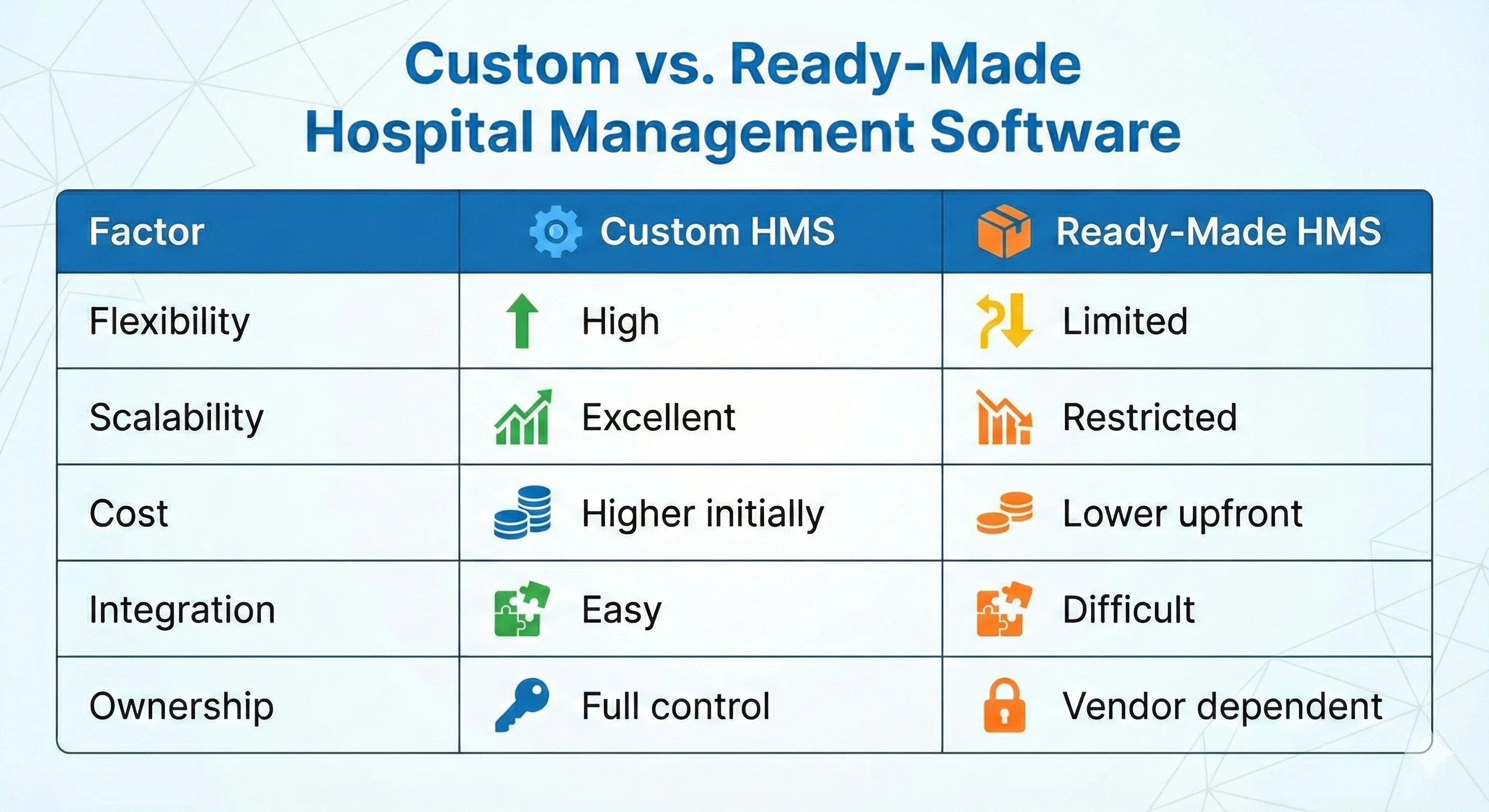
Most growing healthcare organizations prefer custom hospital software development for long-term scalability.
Improved patient care quality through complete information availability, clinical decision support, care coordination, and reduced medical errors. Facilities report 20-30% error reductions and better patient outcomes.
Enhanced operational efficiency through workflow automation, resource optimization, reduced paperwork, and staff productivity. Hospitals report 30-50% productivity improvements in administrative functions.
Financial benefits from accurate billing, reduced claim denials, faster collection, and fraud prevention. Facilities typically see 15-25% revenue increases through better billing accuracy and efficiency.
Regulatory compliance ensuring data protection, accreditation readiness, government reporting, and audit trails. Automated compliance reduces violation risks and simplifies audits.
Data-driven decision making through analytics providing operational, financial, clinical, and patient satisfaction insights. Management improves strategic planning and enables evidence-based decisions.
Secuodsoft, a CMMI Level 3 appraised AI-first solution company, brings comprehensive expertise to healthcare management software development.
Investing in Hospital Management Software Development is no longer optional , it is essential for healthcare organizations aiming to improve efficiency, patient care, and profitability.
Whether you operate a clinic, diagnostic center, or multi-specialty hospital, a customized Hospital Management System can transform your operations and future-proof your business.
Copyright ©2026 Secuodsoft. All rights reserved.